


EJ Research Highlight: Helping Environmental Justice Take Root
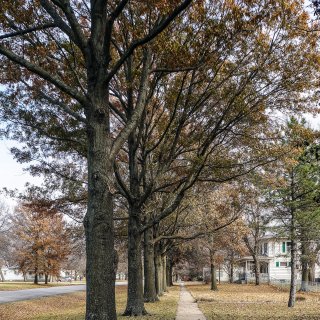
“So When Have Trees Existed Only for Rich Americans?” That was the provocative question Ian Leahy and Yarnya Serkez posed to headline a recent opinion article in The New York Times. They go on to describe how disparities in urban tree cover leave people living in lower income communities without the considerable benefits trees provide. Using a fine-scale map showing tree cover across the City of Philadelphia, they illustrate how a neighborhood with a median annual income in the $130,000 range “…enjoys lush greenery and cooling shade, with more than 60 percent of the surface covered in trees.” In contrast, a neighborhood with a median household income around $37,000 had tree cover of just six percent—and an average annual temperature more than 10 degrees higher. The writers outline some of the historical factors that have persistently kept certain communities from enjoying the environmental and public health benefits linked to tree cover and other green spaces.
Ending that history, and bringing the benefits of environmental protection to everyone regardless of their race, income, or location is at the heart EPA’s commitment to advancing environmental justice (EJ).
To meet that commitment, the Agency’s Office of Research and Development employs a rigorous, multidisciplinary program of study aimed at shedding light on how community-level social and demographic factors are related to environmental risks and benefits.
EPA researchers are working to increase the understanding of how such factors, in combination with environmental exposures to pollutants and other contaminants, and aspects of the local environment—both human built and natural ecosystems—contribute to the disproportionate health risks and other impacts that low-income and other vulnerable communities face.
EPA’s research portfolio has been developed in close partnership with community stakeholders, public health officials, educators, local governments, civic groups, and other stakeholder so that it delivers the information they need to take action. With that input, EPA has strategically identified three main topic areas to guide its EJ research: developing methods for assessing cumulative impacts in communities, supporting Tribal science, and characterizing climate justice. Acknowledging the urgency to reduce ongoing environmental public health risks exacerbated by both decades of inequality and the unfolding climate crisis, the primary goal is to provide resources to support local actions. Researchers have developed a suite of decision-support tools, including the following:
EnviroAtlas
For communities looking to harness the benefits of trees and other ecosystem services—the benefits people receive from nature—there is EnviroAtlas. A free, web-based resource, it provides geospatial data, easy-to-use tools, and other information related to ecosystem services, their chemical and non-chemical stressors, and human health for the United States at national and community scales. Users can use EnviroAtlas to prioritize urban tree-planting, identify solutions to reduce heat islands, and explore the use of vegetative buffers to reduce near-roadway pollution exposure. For these and more examples, see EnviroAtlas Use Cases.
EJSCREEN
EJSCREEN is an environmental justice mapping and screening tool that provides EPA with a nationally consistent dataset and approach for combining environmental and demographic indicators. Users choose a geographic area to access its site-specific demographic and environmental information. EJSCREEN provides a way to display this information and includes a method for combining environmental and demographic indicators into EJ indexes. All of the EJSCREEN indicators are publicly-available data.
Learn more and access EJSCREEN
Proctor Creek Story Map
The Proctor Creek Watershed Story Map is an easy-to-use, interactive, online resource that combines maps with narrative text, images, and multimedia content on a case study of how research and collaboration can advance community-led environmental justice actions. The story map highlights work in the Proctor Creek watershed in Atlanta—home to some of the city’s most economically disadvantaged and underserved areas—to address community-identified concerns such as flooding, water quality, urban heat islands, mosquito populations, and public health.
The National Stormwater Calculator (SWC)
Like Proctor Creek (see previous example), many disadvantaged communities face the challenges of flooding and contamination from excess stormwater runoff and inadequate sewer infrastructure. SWC provides them with a powerful tool for informing mitigation actions. It is a software application to estimate the annual amount of stormwater runoff from a specific location in the United States, (including Puerto Rico), based on local soil conditions, land cover, and historic rainfall records. It includes a cost estimation module, which allows users to evaluate low-impact development controls to meet stormwater retention targets, with or without the use of green infrastructure.
Learn more about SWC, see a highlight video, and download the mobile app
Smoke Sense
Climate change is driving an increase in wildfires, leading to deteriorating and often unhealthy air quality. This can be particularly harmful to those already suffering from compromised cardiovascular health, or living in communities subjected to air pollution from nearby sources such as major roadways and industry. Smoke Sense is a mobile application that supports citizen science projects aimed at increasing awareness of the health effects associated wildfire smoke exposure. Participants can use the app to explore maps of current and forecasted air quality and smoke conditions, learn how to protect their health from wildfire smoke, and record their personal smoke experiences and any concurrent health symptoms. The Smoke Sense app is available in both English and Spanish.
Learn more and download the app
Regardless of when it started, EPA is committed to helping usher out the of the era of when trees are an exclusive feature of rich neighborhoods. As former EPA Administrator Michael Regan noted in his remarks at the Michigan EJ Conference in May 2021, “I’m proud that environmental justice is finally taking its rightful place across the entire federal government – not as an add on or afterthought – but as a central driving factor in all that we do. At EPA, environmental justice is part of our DNA, because it’s our obligation to empower the people who’ve been left out of the conversation for too long.” The research and tools outlined above will provide the data, tools, and other resources we need to meet that obligation.