U.S. flag

An official website of the United States government

Here’s how you know

Dot gov

Official websites use .gov
A .gov website belongs to an official government organization in the United States.

HTTPS

Secure .gov websites use HTTPS
A lock (LockA locked padlock) or https:// means you’ve safely connected to the .gov website. Share sensitive information only on official, secure websites.

Emergency

This is not the current EPA website. To navigate to the current EPA website, please go to www.epa.gov. This website is historical material reflecting the EPA website as it existed on January 19, 2025. This website is no longer updated and links to external websites and some internal pages may not work. More information »

    • Environmental Topics
    • Air
    • Bed Bugs
    • Cancer
    • Chemicals, Toxics, and Pesticide
    • Climate Change
    • Emergency Response
    • Environmental Information by Location
    • Environmental Justice
    • Greener Living
    • Health
    • Land, Waste, and Cleanup
    • Lead
    • Mold
    • Radon
    • Research
    • Science Topics
    • Water Topics
    • A-Z Topic Index
    • Laws & Regulations
    • By Business Sector
    • By Topic
    • Compliance
    • Enforcement
    • Laws and Executive Orders
    • Regulations
    • Report a Violation
    • Environmental Violations
    • Fraud, Waste or Abuse
    • About EPA
    • Our Mission and What We Do
    • Headquarters Offices
    • Regional Offices
    • Labs and Research Centers
    • Planning, Budget, and Results
    • Organization Chart
    • EPA History
    • Staff Directory

Breadcrumb

  1. Home
  2. Environmental Geophysics

Geomechanical (Engineering) Properties

Seismic velocities can be related to standard geotechnical properties. For example, Poisson's ratio ν can be found from:
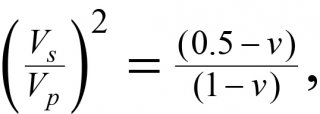
Poisson's ratio

(1)

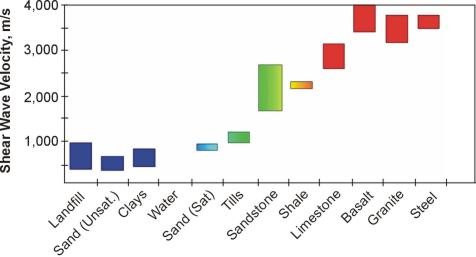
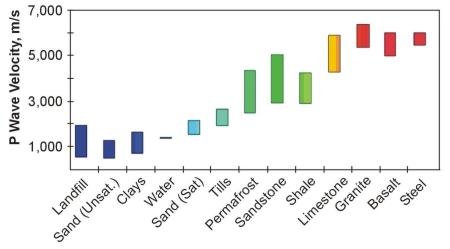
Figures 1 and 2 show the S and P wave velocities of seismic waves for a number of different rock types.
S-wave velocity ranges
Figure 1.  S-wave velocity ranges for common materials.
P wave velocity ranges
Figure 2.  P wave velocity ranges for common materials.

The pages found under Properties are substantially based on a report produced by the United States Department of Transportation:

Wightman, W. E., Jalinoos, F., Sirles, P., and Hanna, K. (2003). "Application of Geophysical Methods to Highway Related Problems." Federal Highway Administration, Central Federal Lands Highway Division, Lakewood, CO, Publication No. FHWA-IF-04-021, September 2003.

Environmental Geophysics

  • About Environmental Geophysics
    • Frequent Questions
  • Tools
    • Decision Support
    • Geophysics Software Utilities
    • Forward Models
    • Inverse Models
  • Resources
    • Geophysical Methods
      • Borehole Geophysical Methods
      • Surface Geophysical Methods
      • Waterborne Geophysical Methods
    • Geophysical Properties
      • Dielectric Permittivity
      • Density
      • Porosity
      • Magnetic Susceptibility
      • Electrical Conductivity and Resistivity
      • Electromagnetic Properties
      • Electromagnetic Signal Attenuation
      • Seismic Velocities
      • Seismic Reflectivity
    • Geophysical References
    • Inversion
  • Publications
  • Related Links
Contact Us about Environmental Geophysics
Contact Us about Environmental Geophysics to ask a question, provide feedback, or report a problem.
Last updated on October 22, 2024
  • Assistance
  • Ayuda
  • Arabic
  • Chinese (simplified)
  • Chinese (traditional)
  • Aide
  • Asistans
  • Korean
  • Assistência
  • Russian
  • Tulong
  • Vietnamese
United States Environmental Protection Agency

Discover.

  • Accessibility Statement
  • Budget & Performance
  • Contracting
  • EPA www Web Snapshot
  • Grants
  • No FEAR Act Data
  • Plain Writing
  • Privacy
  • Privacy and Security Notice

Connect.

  • Data
  • Inspector General
  • Jobs
  • Newsroom
  • Regulations.gov
  • Subscribe
  • USA.gov
  • White House

Ask.

  • Contact EPA
  • EPA Disclaimers
  • Hotlines
  • FOIA Requests
  • Frequent Questions

Follow.