


Los Angeles Area Environmental Enforcement Collaborative
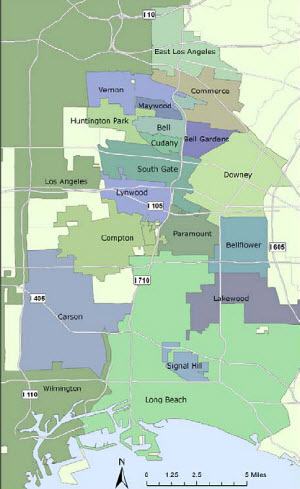
The densely populated communities closest to the I-710 freeway in Los Angeles County are severely impacted by pollution from goods movement and industrial activity. In a multiyear effort, a unique collaboration of federal, state, and local governments and nonprofit organizations will work together to improve the environmental and public health conditions for residents along this corridor.
Members of the Collaborative Will:
- Partner with community leaders to identify pollution sources, “ground-truth” agency data sources, and develop plans for immediate action;
- Improve compliance with environmental laws by targeting inspections and enforcement at the state, federal, and local levels to address the pollution sources of most concern to communities;
- Build on the existing community partnerships and the targeted enforcement efforts of CalEPA’s Department of Toxic Substances Control (DTSC);
- and Sustain multi-year partnerships with communities, offering voluntary programs, tools, capacity-building grant opportunities, educational information, and training.
Environmental and Health Challenges in the Los Angeles Goods Movement and Industrial Corridor
- The Ports of Long Beach and Los Angeles are the entry point of 40% of all imports to the U.S. and 20% of diesel particulate emissions in Southern California.
- Approximately 2,000 premature deaths are associated with diesel emissions in the South Coast Air Basin.
- The I-710 freeway passes through 15 cities and unincorporated areas with a population of over 1 million residents – about 70% of which are minority and disproportionately low income populations. The area is dense with truck traffic, industrial facilities, residences, schools, daycares, and senior centers.
- The region has persistently exceeded national air quality standards for carbon monoxide,1-hour and 8-hour ozone, and particulate matter 2.5 and 10.
- The American Lung Association’s “State of the Air 2009” Report identifies Los Angeles as the most polluted city in the nation by its levels of ozone and particulate pollution.
Strategies
Each community along the corridor is unique with specific and multiple pollution concerns. In 2009, we will partner with communities, proactively identify community concerns, and work with partner agencies to identify resources available to address problems. We will also assist partner communities in building capacity through training, grants, voluntary programs, and technical assistance.
The community of Maywood, located at the northern end of the 710 corridor, is the first partner in this effort. Maywood is one of the most densely populated cities in California, and is bordered by the highly-industrial cities of Vernon and Commerce. Local community organizations such as Padres Unidos de Maywood (PUMA) and Comité Pro Uno have organized as part of a Maywood Community Partnership with local, state, and federal regulatory agencies to identify, prioritize, and address their environmental problems. The Collaborative will use the results of Maywood’s community-driven “ground-truthing” exercise to identify potential targets for inspection and compliance efforts.
In 2010 and 2011, the Collaborative will work to replicate this effort in other communities along the corridor. Member agencies will target inspection and enforcement resources in areas of concern to communities. We will also build on DTSC’s successful use of community-led tours and workshops followed by return visits to communities, to report progress and results.
DTSC will work with community representatives and local, state and federal regulatory agencies (e.g., Waterboards, air quality and public health agencies, etc.) to coordinate environmental pollution mitigating activities including inspection and enforcement activities, ground-truthing (“spotting” legal and illegal) real sources of environmental pollution in and around communities and schools in the Cities of Bell, Cudahy, and Maywood which are densely populated, low-income, primarily Latino communities in the heart of Los Angeles County.