


Scientific Integrity at EPA
On This Page:
- Overview
- What is Scientific Integrity?
- Why is Scientific Integrity Important?
- Executive Branch Reaffirms Commitment to Scientific Integrity
- History of the Development of EPA's Scientific Integrity Policy
Overview
Scientific integrity at EPA is the responsibility of every employee, contractor, grantee, volunteer and collaborator who conducts, utilizes, supervises, manages, communicates, or influences scientific activities. The Scientific Integrity Policy exists against a complicated regulatory backdrop. For example, the Scientific Integrity Policy works in conjunction with policies and procedures for addressing research misconduct, information quality, quality assurance, and peer review. The policy also works in conjunction with statutes such as the Freedom of Information Act and Federal Advisory Committee Act.
What is Scientific Integrity?
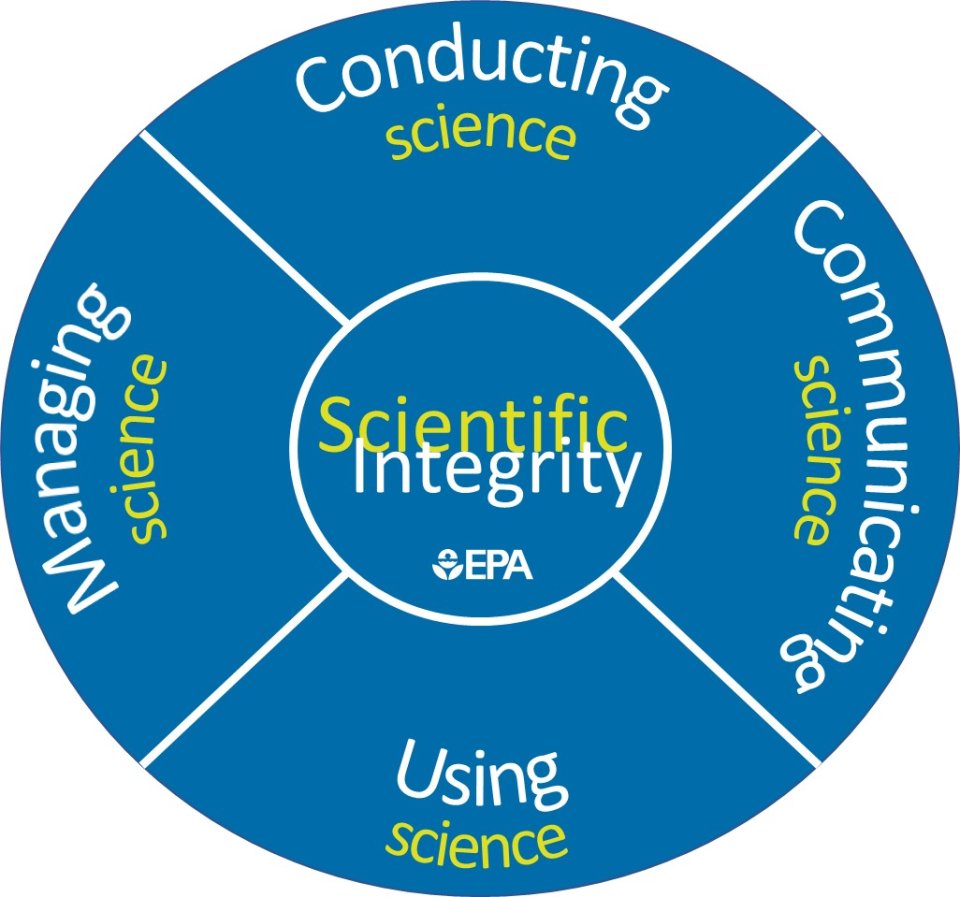
Scientific integrity results from adherence to professional values and practices, when conducting and applying the results of science and scholarship. It ensures:
- Objectivity
- Clarity
- Reproducibility
- Utility
Scientific integrity is important because it provides insulation from:
- Bias
- Fabrication
- Falsification
- Plagiarism
- Outside interference
- Censorship
- Inadequate procedural and information security
Federal Definition of Scientific Integrity
EPA's Scientific Integrity Policy adopted the federal definition of scientific integrity from the Office of Science and Technology Policy's A Framework for Federal Scientific Integrity Policy and Practice:
Scientific Integrity is the adherence to professional practices, ethical behavior, and the principles of honesty and objectivity when conducting, managing, using the results of, and communicating about science and scientific activities. Inclusivity, transparency, and protection from inappropriate influence are hallmarks of scientific integrity.
Why is Scientific Integrity Important?
- Scientific integrity helps to build public support. People are more likely to support the Agency if they can trust the quality and integrity of its work.
- Scientific integrity, along with federal policies on research misconduct, conflicts of interest, and transparency help to ensure that EPA employees, contractors, and grantees can be held accountable to the public.
- Since EPA research often involves a great deal of cooperation and coordination among many different people in different disciplines and institutions, scientific integrity promotes the values that are essential to collaborative work, such as trust, accountability, and fairness. For example, data sharing policies, and confidentiality rules in peer review are designed to protect intellectual property interests while encouraging collaboration.
- Scientific integrity promotes the aims of research, such as knowledge, truth, and avoidance of error. For example, prohibitions against fabricating, falsifying, or misrepresenting research data promote the truth and avoid error.
- Finally, scientific integrity promotes a variety of other important moral and social values, such as compliance with the law, and health and safety.
Introduction to Scientific Integrity at EPA (2025) Whiteboard Video
EPA’s scientific integrity program’s 2025 whiteboard training video “Introduction to Scientific Integrity at EPA” is an overview of scientific integrity, including EPA’s scientific integrity policy, how to report a scientific integrity concern, what constitutes a violation of the scientific integrity policy and important contact information and resources.
History of the Development of EPA’s Scientific Integrity Policy
While EPA's Scientific Integrity Policy dates from 2012, EPA has a long history of attention to scientific integrity. Many EPA administrators have addressed integrity and transparency in memos to the Agency. Administrator William Ruckelshaus drafted a memo in 1983 establishing a culture of integrity, which was followed in 1989 with one by Administrator William Reilly and another in 1993 by Administrator Carol Browner.
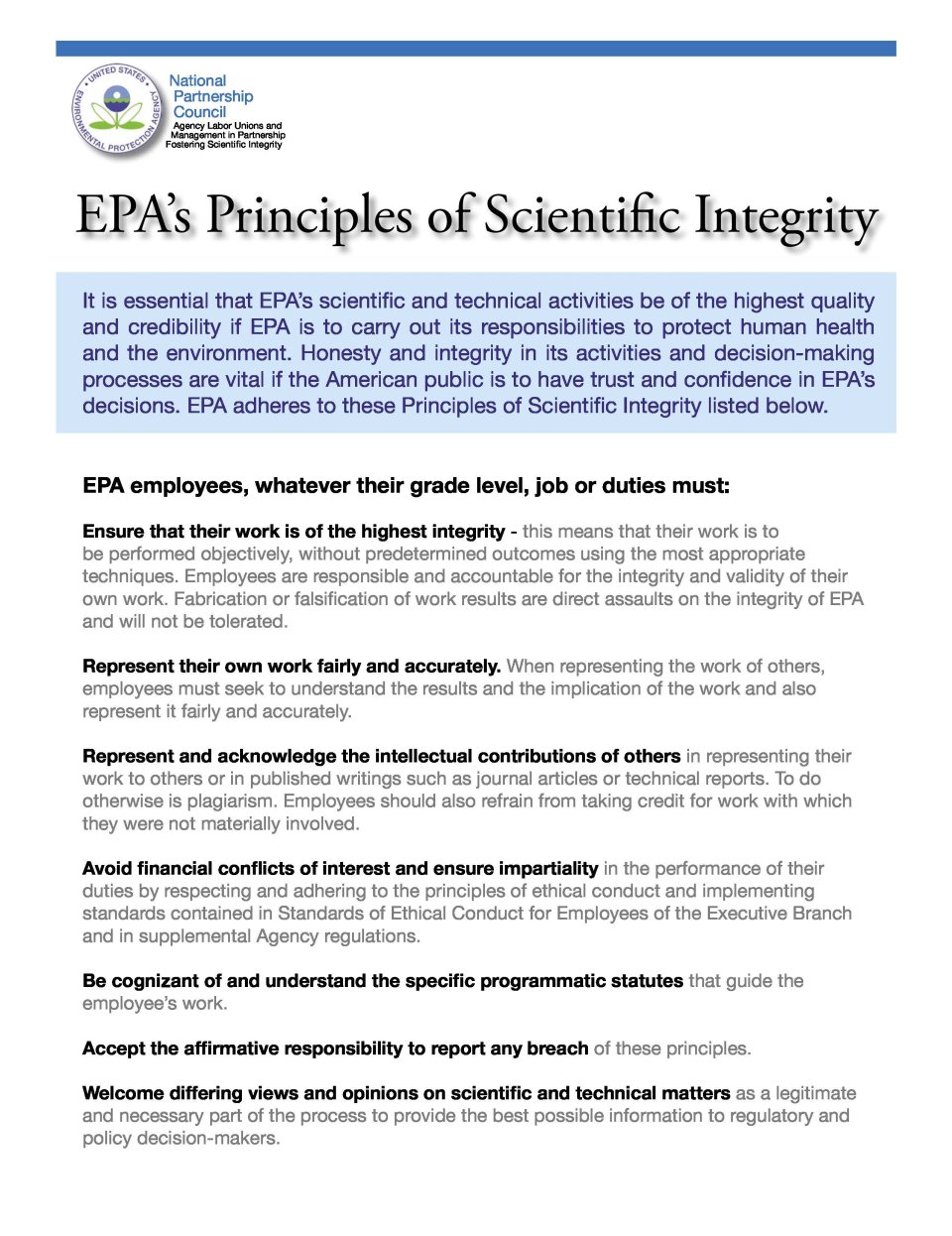
In 1999, the Agency published its Principles of Scientific Integrity, developed in conjunction with the EPA's National Partnership Council, which was comprised of representatives of Agency labor unions and management.
In March 2009, an Executive Memorandum directed the White House Office of Science and Technology Policy (OSTP) to develop a plan aimed at ensuring the integrity of federal science. The memo expressed the need for robust science to inform and guide decisions by Executive Branch departments and agencies. In response, Administrator Lisa Jackson issued a memorandum in May 2009 to all EPA employees that declared "Science must be the compass guiding our environmental protection decisions.…While the laws that EPA implements leave room for policy judgments, the scientific findings on which these judgments are based should be arrived at independently using well-established scientific methods, including peer review, to assure rigor, accuracy, and impartiality."
In December 2010, the White House Office of Science and Technology Policy (OSTP) provided guidance for the development of scientific integrity policies by federal agencies. The guidelines require agencies and departments to create or improve policies related to:
- Foundations of scientific integrity in government
- Public communications
- Use of federal advisory committees
- Professional development of scientists and engineers
Acknowledging differences in structure and degree of regulatory responsibility, agencies and departments were given some latitude in developing their policies.
In response to OSTP, EPA convened an ad hoc scientific integrity working group, with members from across the Agency. A few months later, EPA released its draft policy for public comment. All of the public comments were considered and, in combination with discussions with other Federal agencies, contributed to an improved final policy, which was released in February 2012. Shortly after this, EPA Deputy Administrator Bob Perciasepe issued a memo to all EPA employees announcing EPA’s scientific integrity policy and affirming the Agency’s commitment to scientific integrity.
EPA's Scientific Integrity Policy builds upon EPA's significant earlier scientific integrity efforts, focusing on the:
- Promotion of a culture of scientific integrity throughout the EPA
- Release of scientific information to the public
- Consistent use of peer review and federal advisory committees
- Professional development of government scientists
The Scientific Integrity Policy also established a Scientific Integrity Committee to provide oversight for its implementation. The committee, led by the Scientific Integrity Official, encourages consistent Policy implementation and further bolsters the EPA's broader efforts to ensure the integrity of the Agency's scientific, engineering, and other technical work.
Executive Branch Reaffirms Commitment to Scientific Integrity
On January 12, 2023, the Office of Science and Technology Policy released A Framework for Scientific Integrity Policy and Practice. The Framework provides a "roadmap that will help strengthen scientific integrity policies and practices across the federal government." To learn more, read a summary of its release.
On January 27, 2021, President Biden issued a Memorandum on Restoring Trust in Government Through Scientific Integrity and Evidence-Based Policymaking, which emphasizes the Biden-Harris Administration’s commitment to making evidence-based decisions and developing policies and programs that are guided by the best available scientific data.
On January 20, 2021, President Biden issued the Executive Order on Protecting Public Health and the Environment and Restoring Science to Tackle the Climate Crisis. The Executive Order affirms that “… the Federal Government must be guided by the best science and be protected by processes that ensure the integrity of Federal decision-making.”