


Accomplishments
-
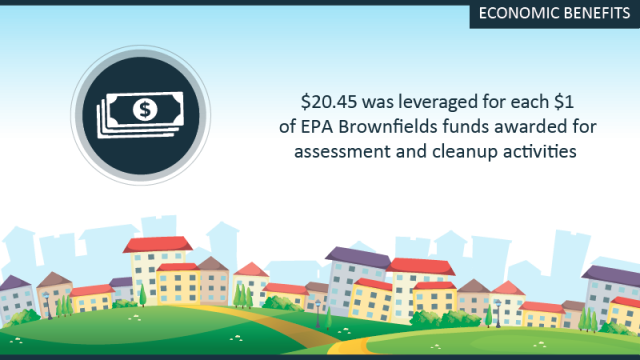
Through fiscal year 2024, on average, $20.45 was leveraged for each EPA Brownfields dollar awarded through assessment, cleanup, multipurpose and revolving loan fund cooperative agreements. Note: Figure includes data associated with grants awarded in FY22 and earlier to account for the fact that leveraging typically occurs several years after award.
-

An estimated $29 to $97 million in additional tax revenue for local governments in a single year after cleanup—2 to 7 times more than the $12.4 million EPA contributed to the cleanup of those brownfields.
-

Through fiscal year 2024, on average, 13.9 jobs were leveraged per $100,000 of EPA Brownfields funds awarded through assessment, cleanup, multipurpose and revolving loan fund cooperative agreements. Note: Figure includes data associated with grants awarded in FY22 and earlier to account for the fact that leveraging typically occurs several years after award.
-

A 2017 study concluded that cleaning up brownfield properties led to residential property value increases of 5 - 15.2% within 1.29 miles of the sites.
-

Redeveloping brownfields reduces residential VMT resulting from new growth by 25-33%. The study results show that, on average, residents living on or near redeveloped brownfield sites are likely to drive less, generating 7.3 to 9.7 fewer VMT per capita per day than if they lived in non-brownfield locations.
-

Redeveloping brownfields reduces jobs-related VMT resulting from new growth by 9-10%. The study results show that, on average, employees who work on or near redeveloped brownfield sites are likely to drive less, generating 2.1 to 2.5 fewer VMT per capita per day than if they worked on non-brownfield locations.
-

Redeveloping brownfields reduces the amount of impervious surface expansion by 73-80%. The study results show that, on average, for every 1 brownfield acre redeveloped, approximately 1.3 to 4.6 acres of new impervious surface will not need to be built.
Brownfields Accomplishments
As of October 1st, 2024
State and Tribal Partner Accomplishments
States and Tribal Nations are responsible for developing brownfield cleanup standards and policy and conducting or overseeing assessment and cleanup of brownfield sites in their jurisdictions. EPA provides funding to help establish or enhance state and tribal response programs. Learn more about the State and Tribal Accomplishments and work.
Enrolled more than
(on average)
Completed more than
Made more than
Environmental and Economic Benefits
In 2020, results from a nationwide assessment (pdf) showed that:
- Redeveloping brownfields sites to accommodate housing and job growth leads to fewer paved impervious surfaces and average vehicle miles traveled per capita/per job compared to accommodating the same amount of growth on previously undeveloped sites.
- Brownfields are often “location-efficient” due to their central location and connections to existing infrastructure.
- 11–13% of the jobs and housing growth expected between 2013–2030 could be supported on brownfield sites.
- Redeveloping brownfields reduces the amount of impervious surface expansion by 73–80%.
- Redeveloping brownfields reduces residential vehicle miles traveled resulting from new growth by 25–33%.
- Redeveloping brownfields reduces job-related vehicle miles traveled resulting from new growth by 9–10%.
- These reductions benefit the environment by:
- Reducing runoff from stormwater and nonpoint pollutant sources.
- Reducing greenhouse gas emissions from vehicle travel.
A 2017 study concluded that cleaning up brownfield properties led to residential property value increases of 5–15.2% within 1.29 miles of the sites.1 Analyzing data near 48 of those brownfields, another study found an estimated $29 to $97 million in additional tax revenue for local governments in a single year after cleanup—2 to 7 times more than the $12.4 million EPA contributed to the cleanup of those brownfields.2 Initial anecdotal surveys indicate a reduction in crime in recently revitalized brownfields areas.
1 Haninger, K., L. Ma, and C. Timmins. 2017. The Value of Brownfield Remediation. Journal of the Association of Environmental and Resource Economists 4(1): 197-241.
2 Sullivan, K. 2017. Brownfields Remediation: Impact of Local Residential Property Tax Revenue. Journal of Environmental Assessment Policy and Management 19(3).