


R1 Success Story: Well Site, Passamaquoddy Tribe, Pleasant Point, Maine

(photo credit: Passamaquoddy Tribe)
EPA Grant Recipient:
Passamaquoddy Tribe
Grant Types:
128(a)
Current Use:
Public Wellhead and Community Space
Former Uses:
Farm
Download Success Story:
Brownfields Success Story: Well Site, Passamaquoddy Tribe, Pleasant Point, Maine (pdf)
A 48-acre site in the Town of Perry that once held a farmhouse and barn was assessed and developed by the Passamaquoddy Tribe to be used as a much-needed public water source and an open green space for tribal events.
The Passamaquoddy Tribe in northeast Maine has historically struggled to get access to clean water. Tests performed by the Passamaquoddy Water District showed the presence of trihalomethanes, a byproduct of chlorination of the tap water. Trihalomethane is a chemical that increases the chances of liver and kidney issues and is thought to cause higher rates of cancer. In 2009, the tribe used its Brownfields response program funding from EPA to start work on the site in hopes of using it for a school but ultimately decided to develop it as a source of clean water open to the public. The tribe has since used $27,000 in EPA funds for that purpose.
Priming the Property for Redevelopment
The two structures on the site, which sits along the ocean and adjacent to the tribe’s Pleasant Point Reservation, were built before 1881, according to historical records. The property hosted a two-story farmhouse and wooden barn, both of which were destroyed by fire, while a septic system installed in 2006 remains. The barn was burned down in the 2000s in a controlled training exercise by the Perry Fire Department. The farmhouse accidentally caught fire in 2014. The location of the septic tank was unknown before recent work on the site began, posing a concern and potential problem for the tribe regarding its condition and impact to the area around it.
(photo credit: Passamaquoddy Tribe)
The tribe began working on the site in 2009 as part of a grant the tribe received from the EPA. This work consisted of a detailed site assessment process, which included a review of historical records, visual site inspections, collection of samples, and determining the location of the septic system. Fortunately, the assessment found no major issues. The tribe then decided to establish a public water supply on this site in conjunction with a new school it had planned to build on a nearby property. The tribe bought the site in 2017 through a private sale. In 2019, the tribe once again used its EPA funding to plan for the reuse of the property. In 2020, they excavated the 1250-gallon septic tank, found it to be in good condition, and verified that it did not pose a threat to the water supply well.
"Our Brownfields Program allowed us to assess the property before it was acquired, but more importantly, we were able use EPA funds to assist in the redevelopment and establish a much-needed resource for our community."
- Dale Mitchell,
Tribal Response Program Lead
Today
(photo credit: Passamaquoddy Tribe)
The tribe is working with the Maine Rural Water District, a local non-profit group, to complete final testing on the site. They are also waiting for the go-ahead from the Maine Drinking Water Program to open the public wellhead. Current local water sources have unknown contaminants and leave a mental burden of stress on the people who rely on it. Many tribal community members now fill jugs and tanks with water provided at private water supply wells, which are drying up due to overuse. A new public wellhead will provide community members with a source of clean and safe drinking water.
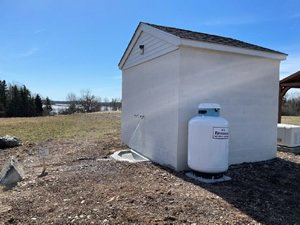
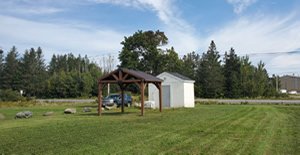
The tribal program plans to use the land as greenspace as it is perfectly positioned space for communal use. An entrance sign was installed, and a gazebo was built to cover the wellhead. As this project evolved, the gazebo was moved off to the side and a concrete well house was built to cover the electric generator and protect the wellhead. This project is helping the Passamaquoddy Tribe gain access to resources they need on tribal land.
| Site Assessment | $24,500 |
|---|---|
| Site Reuse Planning | $2,535 |
| Total Tribal Brownfields Response Program Funds | $27,035 |
For more information:
Visit the EPA Brownfields website at www.epa.gov/brownfields or contact William Lariviere at 617-918-1231 or Lariviere.William@epa.gov.
EPA 901-F-22-003
March 2023