U.S. flag

An official website of the United States government

Here’s how you know

Dot gov

Official websites use .gov
A .gov website belongs to an official government organization in the United States.

HTTPS

Secure .gov websites use HTTPS
A lock (LockA locked padlock) or https:// means you’ve safely connected to the .gov website. Share sensitive information only on official, secure websites.

Emergency

This is not the current EPA website. To navigate to the current EPA website, please go to www.epa.gov. This website is historical material reflecting the EPA website as it existed on January 19, 2025. This website is no longer updated and links to external websites and some internal pages may not work. More information »

    • Environmental Topics
    • Air
    • Bed Bugs
    • Cancer
    • Chemicals, Toxics, and Pesticide
    • Climate Change
    • Emergency Response
    • Environmental Information by Location
    • Environmental Justice
    • Greener Living
    • Health
    • Land, Waste, and Cleanup
    • Lead
    • Mold
    • Radon
    • Research
    • Science Topics
    • Water Topics
    • A-Z Topic Index
    • Laws & Regulations
    • By Business Sector
    • By Topic
    • Compliance
    • Enforcement
    • Laws and Executive Orders
    • Regulations
    • Report a Violation
    • Environmental Violations
    • Fraud, Waste or Abuse
    • About EPA
    • Our Mission and What We Do
    • Headquarters Offices
    • Regional Offices
    • Labs and Research Centers
    • Planning, Budget, and Results
    • Organization Chart
    • EPA History
    • Staff Directory

Breadcrumb

  1. Home
  2. Mississippi River/Gulf of Mexico Hypoxia Task Force
  3. HTF Activities

Hypoxia Task Force Nutrient Reduction Strategies

State and Federal Nutrient Reduction Strategies

State development and implementation of nutrient reduction strategies are a major focus of the Task Force. The first Action Item of the 2008 Action Plan calls for Task Force states to develop by 2013 “comprehensive nitrogen and phosphorus reduction strategies encompassing watersheds with significant contributions of nitrogen and phosphorus to the surface waters of the Mississippi/Atchafalaya River Basin (MARB), and ultimately to the Gulf of Mexico.” State-level strategies allow for a more detailed basis for developing and implementing load reductions and provide a vehicle for coordinating with federal agencies and other MARB states.

Having each state develop and implement its own strategy provides flexibility for tailoring the strategy’s approach and components. At the same time, the Task Force recognizes that all state strategies need to include certain essential components that need to be in every state strategy to achieve goals. States are generally following the framework described in a 2011 EPA Memo.

State Nutrient Reduction Strategies

States continue to implement state nutrient reduction strategies that contain tailored methods for reducing nutrients in their state. Learn more about each state below.

The following links exit the site

  • Arkansas
  • Indiana
  • Illinois
  • Iowa
  • Kentucky
  • Louisiana
  • Minnesota
  • Mississippi
  • Missouri
  • Ohio
  • Tennessee
  • Wisconsin

Each Task Force state has designated priority watersheds as part of their nutrient reduction strategy. A map of the priority watersheds is below. The document Priority Watershed Selection Process details each state's selection process.
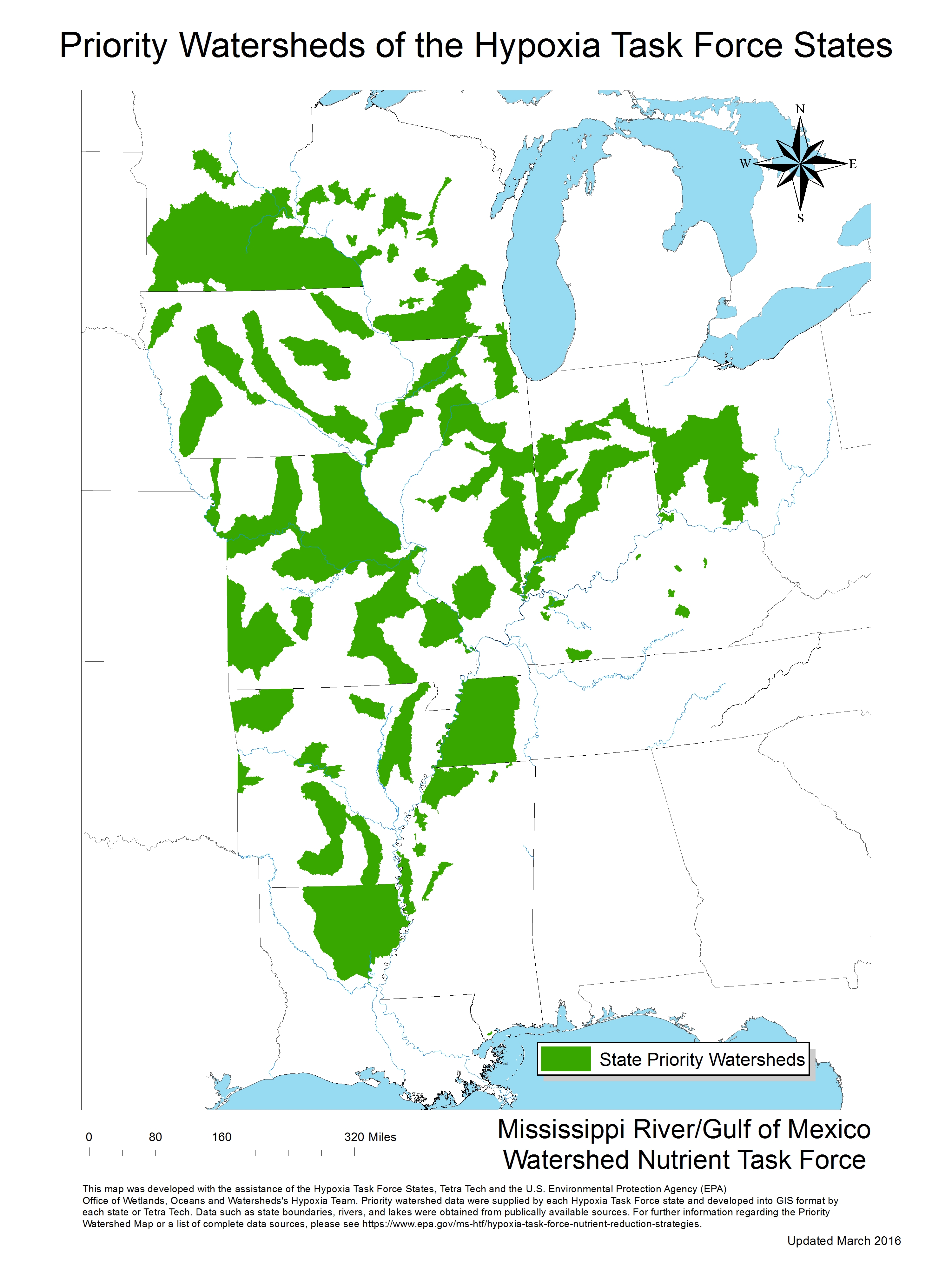
Priority Watersheds of the Hypoxia Task Force States

Federal Nutrient Reduction Strategies

Federal members of the Task Force developed a federal nutrient reduction strategy that addresses federal assistance to Task Force states on nutrient reduction strategies. Looking Forward: The Strategy of the Federal Members of the Hypoxia Task Force describes the ongoing and planned efforts of the federal agencies to support state nutrient reduction strategy development and to address other aspects of the 2008 Action Plan. The appendix to the strategy, completed in September 2012, describes in detail the types of assistance each agency can provide to Task Force states for developing nutrient reduction strategies. The appendix includes a thorough compilation of federal efforts and programs that either directly or indirectly contribute to reducing nitrogen and phosphorus loads, including direct financial and technical support to assist states with their nutrient reduction strategies.

Mississippi River/Gulf of Mexico Hypoxia Task Force

  • Background
    • Current Members
    • History of the HTF
    • Partnerships
    • Related Legislation
  • Goals and Implementation
    • Action Plans and Goal Framework
    • Federal Strategies
    • Implementation
  • Tracking Progress
    • Task Force Success Stories
    • Hypoxic Zone Size
    • Point Source Reports
    • Nonpoint Source Report
    • Reports to Congress
    • Tracking Progress Overview
  • HTF Activities
    • Task Force Newsletters
    • Nutrient Reduction Strategies
    • Task Force Workgroups
    • Recent/Upcoming Task Force Meetings
    • Past Task Force Meetings
  • Resources
    • Gulf Hypoxia Program
    • Task Force Studies/Reports
  • Science of Hypoxia
    • Hypoxia 101
    • The MARB
    • Nutrient Pollution
    • Additional Task Force Resources
Contact Us About the Mississippi River/Gulf of Mexico Hypoxia Task Force
Contact Us About the Mississippi River/Gulf of Mexico Hypoxia Task Force to ask a question, provide feedback, or report a problem.
Last updated on August 9, 2024
  • Assistance
  • Ayuda
  • Arabic
  • Chinese (simplified)
  • Chinese (traditional)
  • Aide
  • Asistans
  • Korean
  • Assistência
  • Russian
  • Tulong
  • Vietnamese
United States Environmental Protection Agency

Discover.

  • Accessibility Statement
  • Budget & Performance
  • Contracting
  • EPA www Web Snapshot
  • Grants
  • No FEAR Act Data
  • Plain Writing
  • Privacy
  • Privacy and Security Notice

Connect.

  • Data
  • Inspector General
  • Jobs
  • Newsroom
  • Regulations.gov
  • Subscribe
  • USA.gov
  • White House

Ask.

  • Contact EPA
  • EPA Disclaimers
  • Hotlines
  • FOIA Requests
  • Frequent Questions

Follow.