U.S. flag

An official website of the United States government

Here’s how you know

Dot gov

Official websites use .gov
A .gov website belongs to an official government organization in the United States.

HTTPS

Secure .gov websites use HTTPS
A lock (LockA locked padlock) or https:// means you’ve safely connected to the .gov website. Share sensitive information only on official, secure websites.

Emergency

This is not the current EPA website. To navigate to the current EPA website, please go to www.epa.gov. This website is historical material reflecting the EPA website as it existed on January 19, 2025. This website is no longer updated and links to external websites and some internal pages may not work. More information »

    • Environmental Topics
    • Air
    • Bed Bugs
    • Cancer
    • Chemicals, Toxics, and Pesticide
    • Climate Change
    • Emergency Response
    • Environmental Information by Location
    • Environmental Justice
    • Greener Living
    • Health
    • Land, Waste, and Cleanup
    • Lead
    • Mold
    • Radon
    • Research
    • Science Topics
    • Water Topics
    • A-Z Topic Index
    • Laws & Regulations
    • By Business Sector
    • By Topic
    • Compliance
    • Enforcement
    • Laws and Executive Orders
    • Regulations
    • Report a Violation
    • Environmental Violations
    • Fraud, Waste or Abuse
    • About EPA
    • Our Mission and What We Do
    • Headquarters Offices
    • Regional Offices
    • Labs and Research Centers
    • Planning, Budget, and Results
    • Organization Chart
    • EPA History
    • Staff Directory

Breadcrumb

  1. Home
  2. Ports Initiative

Section B: Environmental Justice Primer for Ports Good Neighbor Roadmap Overview

icons ej primer home button
icons ej primer section A button
icons ej primer section B button
icons ej primer step 1 button
icons ej primer step 2 button
icons ej primer step 3 button
icons ej primer step 4 button
icons ej primer step 5 button
icons ej primer step 6 button
icons ej primer appendix
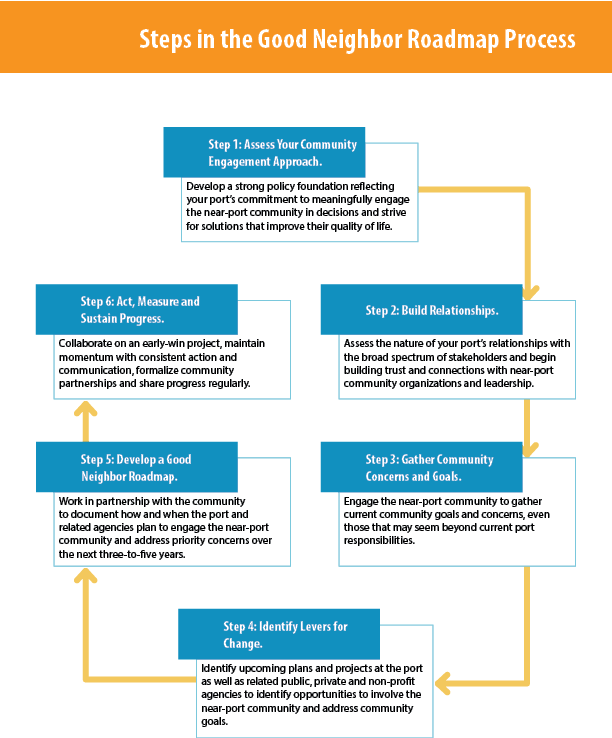
Photo of good neighbor roadmap process
Click for a larger image | Click for a text version of this image

Using the Good Neighbor Roadmap

Have port staff experienced repeated community meetings characterized by anger and frustration? Or spent hours responding to public comments that do not seem related to the decision at hand? These are common agency experiences when sharing decisions with highly impacted communities. However, they can often be avoided by taking a proactive approach to building community relationships.

This Good Neighbor Roadmap outlines six key steps for effectively engaging communities in ports decision-making. While the steps follow a set order (see diagram  to the right), start with the step that best fits your needs and circumstances. Timeframes for each step will vary depending on the local context. Over time, port decision-makers may cycle through the steps several times as part of addressing new issues and strengthening local partnerships.

Selecting a starting place

The scenarios below provide examples of how different port agencies may approach using the Good Neighbor Roadmap. These scenarios are only two of many situational dynamics that the Roadmap could address.

Scenario A – The community has persistently raised a particular issue and your port is considering how to address it within the scope of port planning and operations. You could start with Step 4 – Identify Levers for Change – and identify plans or projects that might best address the issue. Your port could then choose to circle back to Step 2 – Build Relationships – to assess priority relationships with residents and local organizations.

Scenario B – Your port has to make a decision regarding a new infrastructure project or operational change and needs community input on the proposed plan. Starting at Step 3 helps you identify community issues and goals. Steps 4 and 5 enable you to look for connections between community goals and the proposed plan.  Following a successful community engagement effort, you may decide to work toward capturing the community’s interests and momentum over the long term, by circling back to Step 1 to develop a policy for continued engagement.

Editable and Printable Worksheets: Environmental Justice Primer for Ports (Word) (docx) (75.62 KB, March 2020) (page 4)

Try It Out! Determine a Starting Place

The following assessment is designed to help you determine which step would most benefit your port at the moment. Review the questions and mark “no,” “some” or “yes.” Consider starting with the step in the process that you first marked with a “no” or “some.”

Step Port Assessment Mark “no,” “some” or “yes”
1 Does your port have a robust approach to engaging near-port communities? Does the approach result in consistent positive community outcomes and productive working relationships?  
2 Does your port have strong working relationships with a broad range of community stakeholders, including community members and area organizations representing near-port residents?  
3 Is your port aware of the range of near-port community concerns and needs?  
4 Has your port identified upcoming plans and projects that may be able to address specific near-port community concerns?  
5 Does your port have a Good Neighbor Roadmap with specific actions and priorities that address community needs and mitigate impacts on near-port communities?  
6 Does your port have a Community Advisory Group that helps integrate local goals into planning and decision-making? Does your port have a way to measure and track community engagement success relative to local goals and priorities?  

« Environmental Justice Primer for Ports: How Are Ports Engaging Communities?
Environmental Justice Primer for Ports Good Neighbor Roadmap: Step 1. Assess your Community Engagement Approach »

Ports Initiative

  • About EPA Ports Initiative
  • Funding
    • Clean Ports Program
    • Funding Opportunities
    • Tips For a Successful Application
    • DERA Grants Awarded for Port Projects
  • Best Clean Air Practices
    • Case Studies
    • SmartWay
  • Technical Resources
    • Ports and Goods Movement Emission Inventories
    • National Port Strategy Assessment
    • EPA and Port Everglades Partnership
    • Shore Power Technology
  • Educational Events
  • Community-Port Collaboration
Contact Us About the EPA Ports Initiative
Contact Us About the EPA Ports Initiative to ask a question, provide feedback, or report a problem.
Last updated on December 10, 2024
  • Assistance
  • Ayuda
  • Arabic
  • Chinese (simplified)
  • Chinese (traditional)
  • Aide
  • Asistans
  • Korean
  • Assistência
  • Russian
  • Tulong
  • Vietnamese
United States Environmental Protection Agency

Discover.

  • Accessibility Statement
  • Budget & Performance
  • Contracting
  • EPA www Web Snapshot
  • Grants
  • No FEAR Act Data
  • Plain Writing
  • Privacy
  • Privacy and Security Notice

Connect.

  • Data
  • Inspector General
  • Jobs
  • Newsroom
  • Regulations.gov
  • Subscribe
  • USA.gov
  • White House

Ask.

  • Contact EPA
  • EPA Disclaimers
  • Hotlines
  • FOIA Requests
  • Frequent Questions

Follow.