U.S. flag

An official website of the United States government

Here’s how you know

Dot gov

Official websites use .gov
A .gov website belongs to an official government organization in the United States.

HTTPS

Secure .gov websites use HTTPS
A lock (LockA locked padlock) or https:// means you’ve safely connected to the .gov website. Share sensitive information only on official, secure websites.

Emergency

This is not the current EPA website. To navigate to the current EPA website, please go to www.epa.gov. This website is historical material reflecting the EPA website as it existed on January 19, 2025. This website is no longer updated and links to external websites and some internal pages may not work. More information »

    • Environmental Topics
    • Air
    • Bed Bugs
    • Cancer
    • Chemicals, Toxics, and Pesticide
    • Climate Change
    • Emergency Response
    • Environmental Information by Location
    • Environmental Justice
    • Greener Living
    • Health
    • Land, Waste, and Cleanup
    • Lead
    • Mold
    • Radon
    • Research
    • Science Topics
    • Water Topics
    • A-Z Topic Index
    • Laws & Regulations
    • By Business Sector
    • By Topic
    • Compliance
    • Enforcement
    • Laws and Executive Orders
    • Regulations
    • Report a Violation
    • Environmental Violations
    • Fraud, Waste or Abuse
    • About EPA
    • Our Mission and What We Do
    • Headquarters Offices
    • Regional Offices
    • Labs and Research Centers
    • Planning, Budget, and Results
    • Organization Chart
    • EPA History
    • Staff Directory

Breadcrumb

  1. Home
  2. Adaptation Organon
  3. Inclusive Collaboration
  4. Introduction to Inclusive Collaboration

How Can I Use the Organon?

The Organon has a variety of uses:  
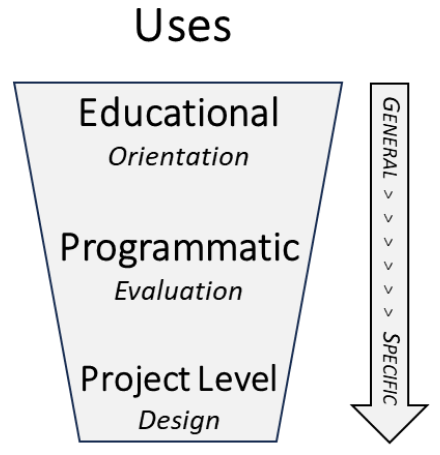
Organon uses include educational, programmatic, and project-level

Basic orientation and education: The Organon can be used by anyone interested in a basic introduction to the key components and principles of resilience-based planning and action. Under "Explore the Steps," click on any bubble to see a general explanation for that step; within a step, click on "Ecosystem Examples" to see how four ecosystem studies that were used to develop the Organon inspired that step.  

Program evaluation: Program managers can use the Organon as a programmatic organizing framework to help brainstorm improved adaptation of existing work, review what work is already occurring or still needed, and examine how internal work links together across steps.  

Project planning: Project practitioners can use the Organon as a logic model with a working group of subject matter experts to guide a detailed, systematic design process across all steps to achieve a particular project goal.  

The Organon is not meant to be rigid or prescriptive; instead, it is intended to be adaptive to project needs as identified through inclusive collaboration processes. If a project is already underway, it can be used at any step to assess the status of that step and its relationship to other steps in whatever order works best. The step contents are also meant to be interpreted flexibly; only certain elements of a step may apply in some cases. For instance, in Step 2 a single site may already have been identified for a project through an earlier process, such that a prioritization exercise is not necessary; however, site evaluation would still be needed to understand local vulnerabilities before site-specific interventions could be appropriately selected and designed.  

These and other examples of flexible interpretations and uses of the Organon can be explored in the "Ecosystem Examples" and "Partner Projects" sections. 

Adaptation Organon

  • About the Organon
    • What Key Concepts Are Behind the Organon?
    • How Can I Use the Organon?
  • Explore the Steps
  • Ecosystem Examples
    • Coral Reef
    • Cold Water Fish
    • Stream
    • Salt Marsh
  • Inclusive Collaboration
    • Introduction to Inclusive Collaboration
    • Organon Collaboration Best Practices
      • Overarching Best Practices
      • Best Practices by Step
  • Partner Projects
    • Region 9 Wetland Program Development Grants
    • Region 3 Chesapeake Bay Solutions-Driven Research Project
    • Region 5 Red Lake Nation Stream Monitoring and Management
  • Resources
Contact Us About the Organon
Contact Us About the Organon to ask a question, provide feedback, or report a problem.
Last updated on December 9, 2024
  • Assistance
  • Ayuda
  • Arabic
  • Chinese (simplified)
  • Chinese (traditional)
  • Aide
  • Asistans
  • Korean
  • Assistência
  • Russian
  • Tulong
  • Vietnamese
United States Environmental Protection Agency

Discover.

  • Accessibility Statement
  • Budget & Performance
  • Contracting
  • EPA www Web Snapshot
  • Grants
  • No FEAR Act Data
  • Plain Writing
  • Privacy
  • Privacy and Security Notice

Connect.

  • Data
  • Inspector General
  • Jobs
  • Newsroom
  • Regulations.gov
  • Subscribe
  • USA.gov
  • White House

Ask.

  • Contact EPA
  • EPA Disclaimers
  • Hotlines
  • FOIA Requests
  • Frequent Questions

Follow.