U.S. flag

An official website of the United States government

Here’s how you know

Dot gov

Official websites use .gov
A .gov website belongs to an official government organization in the United States.

HTTPS

Secure .gov websites use HTTPS
A lock (LockA locked padlock) or https:// means you’ve safely connected to the .gov website. Share sensitive information only on official, secure websites.

Emergency

This is not the current EPA website. To navigate to the current EPA website, please go to www.epa.gov. This website is historical material reflecting the EPA website as it existed on January 19, 2025. This website is no longer updated and links to external websites and some internal pages may not work. More information »

    • Environmental Topics
    • Air
    • Bed Bugs
    • Cancer
    • Chemicals, Toxics, and Pesticide
    • Climate Change
    • Emergency Response
    • Environmental Information by Location
    • Environmental Justice
    • Greener Living
    • Health
    • Land, Waste, and Cleanup
    • Lead
    • Mold
    • Radon
    • Research
    • Science Topics
    • Water Topics
    • A-Z Topic Index
    • Laws & Regulations
    • By Business Sector
    • By Topic
    • Compliance
    • Enforcement
    • Laws and Executive Orders
    • Regulations
    • Report a Violation
    • Environmental Violations
    • Fraud, Waste or Abuse
    • About EPA
    • Our Mission and What We Do
    • Headquarters Offices
    • Regional Offices
    • Labs and Research Centers
    • Planning, Budget, and Results
    • Organization Chart
    • EPA History
    • Staff Directory

Breadcrumb

  1. Home
  2. Adaptation Organon
  3. Inclusive Collaboration
  4. Introduction to Inclusive Collaboration

What Key Concepts Are Behind the Organon?

Environmental management aims to protect, restore and conserve functional, resilient, and self-sustaining natural systems. Resilient natural resources ensure the provision of resilient ecosystem services for resilient human communities. 

Boosting resilience depends on: 

  1. understanding vulnerability (the degree of exposure to threats plus the sensitivity and adaptive capacity of the system to resist or recover); and
  2. creating new management strategies to reduce vulnerability to rapidly changing environmental conditions. 
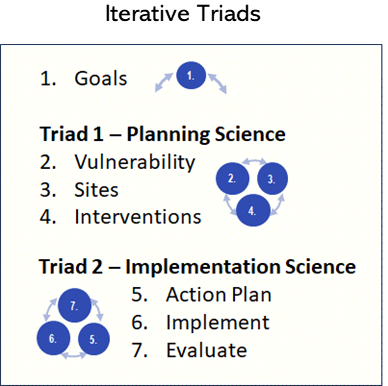
Iterative Triads of the Organon reflect the fluid nature of planning science (steps two-three-four) and implementation science (steps five-six-seven).

Achieving resilience requires a coordinated flow of information between planning science (Triad 1) and implementation science (Triad 2) to inform continuous evaluation and improvement of adaptive management outcomes. 

The Organon’s double-sided arrows and spinning triads reflect this highly fluid and iterative process, where advances in any one step can power further refinements in other steps:  

Step 1. Goals: Clearly defined goals are an essential start for bounding and guiding a focused effort. Everything that follows is devised in the context of the goal, and the goal may need to be reconsidered through time based on what is learned in any step. 

Triad 1, Steps 2-3-4: Vulnerability assessments are tailored to inform site evaluation and intervention design, with iterative learning marking the interconnected nature of these steps. The combined planning information then informs Triad 2. 

Triad 2, Steps 5-6-7: Here, action planning uses information from Triad 1 and specifies monitoring methods to track the implementation of interventions and evaluate success at achieving intended outcomes. This process could result in ongoing improvements to the action plan, again underscoring the interconnected nature of these steps.  

Inclusive collaboration through community engagement and public participation is essential throughout this iterative process. Partnering with local leaders, interest groups, community members, and experts supplements scientific efforts with place-based knowledge, ensures informed decision-making as the work evolves, and fosters community ownership of results.  

Throughout the collaborative process, a project may have multiple iterations of information flow between triads, among steps within triads, and even back to step one for re-evaluation and adjustment of goal and scope, thereby closing the Organon circle.

Adaptation Organon

  • About the Organon
    • What Key Concepts Are Behind the Organon?
    • How Can I Use the Organon?
  • Explore the Steps
  • Ecosystem Examples
    • Coral Reef
    • Cold Water Fish
    • Stream
    • Salt Marsh
  • Inclusive Collaboration
    • Introduction to Inclusive Collaboration
    • Organon Collaboration Best Practices
      • Overarching Best Practices
      • Best Practices by Step
  • Partner Projects
    • Region 9 Wetland Program Development Grants
    • Region 3 Chesapeake Bay Solutions-Driven Research Project
    • Region 5 Red Lake Nation Stream Monitoring and Management
  • Resources
Contact Us About the Organon
Contact Us About the Organon to ask a question, provide feedback, or report a problem.
Last updated on December 9, 2024
  • Assistance
  • Ayuda
  • Arabic
  • Chinese (simplified)
  • Chinese (traditional)
  • Aide
  • Asistans
  • Korean
  • Assistência
  • Russian
  • Tulong
  • Vietnamese
United States Environmental Protection Agency

Discover.

  • Accessibility Statement
  • Budget & Performance
  • Contracting
  • EPA www Web Snapshot
  • Grants
  • No FEAR Act Data
  • Plain Writing
  • Privacy
  • Privacy and Security Notice

Connect.

  • Data
  • Inspector General
  • Jobs
  • Newsroom
  • Regulations.gov
  • Subscribe
  • USA.gov
  • White House

Ask.

  • Contact EPA
  • EPA Disclaimers
  • Hotlines
  • FOIA Requests
  • Frequent Questions

Follow.