


Region 9 Wetland Program Development Grants
Quick Look 
Assist EPA Region 9 staff with updating the Request for Applications (RFA) document for the FY23-24 round of Wetland Program Development Grants (WPDG), to highlight climate change resilience- and environmental justice (EJ)-based planning priorities for State and Tribal applicants in support of proposal development.
Process:
- Use the Organon's planning components to organize guidance found in EPA Office of Water's Tribal, State, and Territory Wetlands Program Core Elements Framework in the areas of: 1) monitoring and assessment; 2) regulatory approaches; 3) voluntary restoration and protection; and 4) water quality standards for wetlands.
- Explore the connections of the different core elements to the instructions of the RFA and the Organon’s specifications for resilience- and EJ-based planning.
- Guidance on the key components of resilience-based planning in the context of WPDGs.
- A table in the R9 RFA (pages 11-12) featuring specific examples of how to address resilience and EJ considerations in a WPDG application.
Background
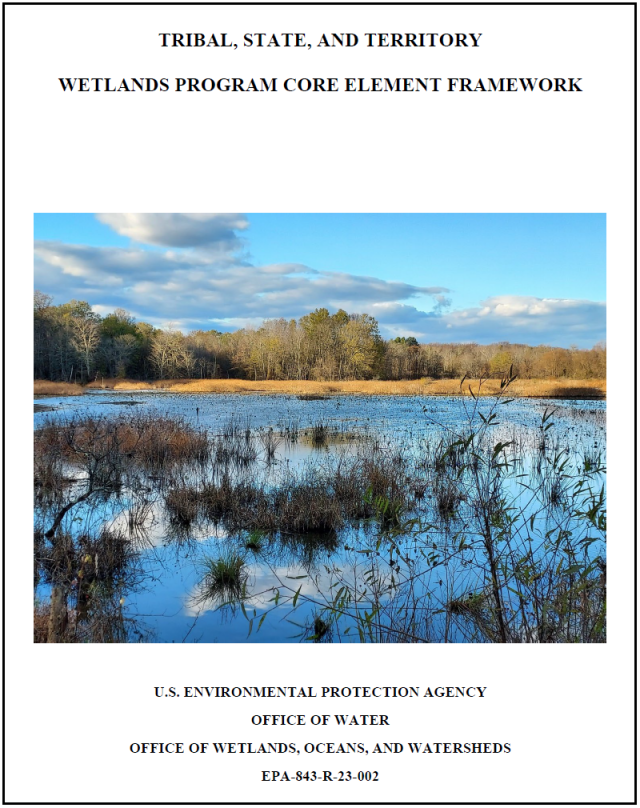
The EPA's WPDGs assist state, tribal, and local government agencies in building programs to protect, manage and restore wetlands. Through this program, applicants build their capacity to increase the quantity and quality of U.S. wetlands using one or more of the "Core Elements" in the Core Elements Framework (Figure 1). These elements describe programmatic areas centered on: monitoring and assessment; voluntary restoration and protection; regulatory approaches; and water quality standards for wetlands. Region 9 grants are awarded every other fiscal year (FY) on a two-year cycle.
Applicants submit proposals in response to a Request for Applications (RFA) released each cycle. For FY23-24, national priorities included climate change and Justice40; individual EPA regions then had the option to highlight specific regional priorities. EPA Region 9, which includes Arizona, California, Nevada, Hawaii and the Pacific Island territories of American Samoa, Guam and the Commonwealth of the Northern Mariana Islands, and 148 Tribes, included a priority for projects that address protection and restoration of special aquatic resources increasingly at risk of degradation and destruction. This included a call for more explicit inclusion of both climate change resilience and environmental justice (EJ) as essential considerations to build into FY23-24 State and Tribal WPDG applications. In support of this, Region 9 staff teamed with EPA Office of Research and Development (ORD) to use the resilience-based planning steps of the Organon to develop guidance for WPDG applicants.
Methods
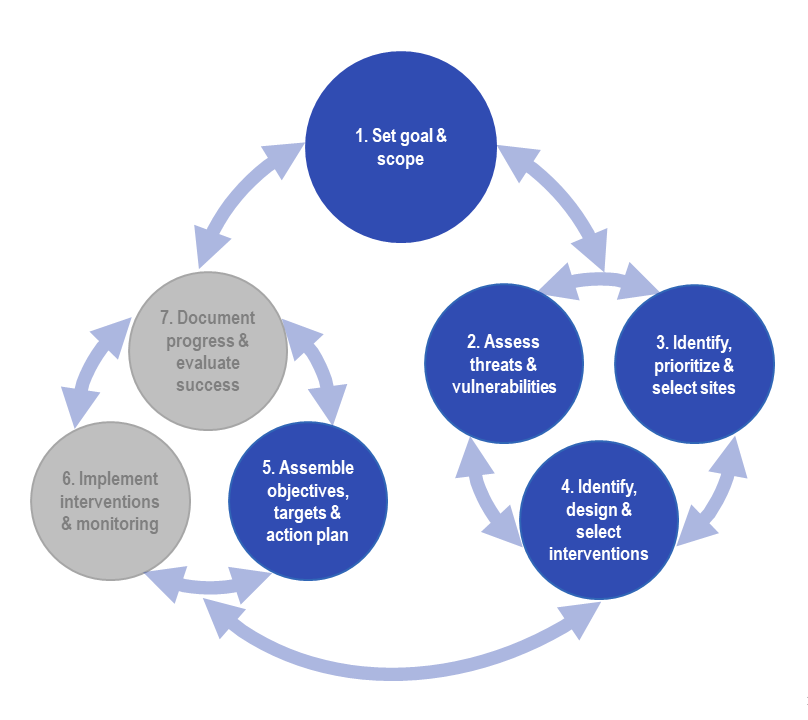
Since WPDGs fund wetland program development (not implementation), the focus of this exercise was the first five components of the Organon, ending at an action plan (Figure 2). The team carried out a comprehensive review of the Core Elements Framework and the national-level RFA, from which concepts, guidance, and references to different aquatic resources were mapped to components of the Organon in which they best fit.
Using this information, for each of the five Organon components (goal setting; vulnerability assessment; site evaluation; intervention design; and action planning) the team developed specific examples illustrating the types of resilience- and EJ-based considerations to address. Depending on whether a proposal would be focused on the core element of monitoring, regulatory approaches, restoration, or water quality, applicants could review examples based on which aspect of program planning applies to them and learn how to specifically address resilience and EJ needs to strengthen their proposals.
Results
Table 1 provides applicants with examples of how to potentially address the regional priority to protect and restore special aquatic resources through the wetland program planning process while minimizing the risks of climate change and addressing the needs of underserved communities. The table lists potentially relevant program planning components (based on key components of the Organon) and illustrates how concepts covered in the RFA could be strengthened by the inclusion of climate resilience and EJ considerations.
Table 1. Examples of how to integrate climate resilience and environmental justice considerations into program planning components.
| POTENTIALLY RELEVANT PROGRAM PLANNING COMPONENTS | EXAMPLE CLIMATE CHANGE RESILIENCE CONSIDERATIONS | EXAMPLE ENVIRONMENTAL JUSTICE CONSIDERATIONS |
|---|---|---|
| Set goal & scope | A goal statement should address what program success will look like under ongoing climate change, for example:
|
Scope could include wetlands that are:
|
| Assess Threats & Vulnerabilities | Assess threats of local and large-scale climate change stressors to resource of interest as well as vulnerabilities of threat exposure and capacity of the resource to resist or recover. For example, when developing regulations to protect ephemeral streams:
|
Include vulnerability of communities to regulation changes due to:
|
| Evaluate & Select Sites | When mapping and selecting sites:
|
Mapping and site selection could include:
|
| Identify, Design & Select Interventions | Consider climate-smart design interventions with selection based on effectiveness under both current and future conditions. For example, a salt marsh restoration program using interventions such as living shorelines could plan to:
|
A Wetland Program Plan could include working with local communities to ensure that selected interventions:
|
| Assemble Objectives, Targets & Action Plan | Considerations for developing a program's action plan could include:
|
Action plan elements for working with historically underserved communities could include:
|
Outcomes
The table was adopted by EPA Region 9 and incorporated in the Region 9 RFA for FY23-24 (see pages 11-12). It was also presented to representatives of other EPA Regions for optional use in evaluating the climate change resilience and EJ aspects of their applicants’ submissions, or for use in the next WPDG cycle.
The FY23-24 applications received by EPA Region 9 are currently under evaluation to determine whether the Organon table resulted in stronger proposals with more explicit climate change resilience and EJ language. This is being analyzed through the use of NVivo software to detect usage of text from the Organon table and the incidence of related words and concepts as qualitative evidence of different language patterns compared to the last cycle of WPDG applications. Winning proposals versus proposals that did not receive funding will also be compared. Results of the effectiveness evaluation will be available in early 2025.
Partner Team
Environmental Protection Agency (EPA) Region 9
Hudson Slay, Life Scientist, EPA Region 9 Water Division
Melissa Scianni, Life Scientist, EPA Region 9 Water Division
Sarvy Mahdavi, Life Scientist, EPA Region 9 Water Division
Joe Morgan, Physical Scientist, EPA Region 9 Water Division
EPA Office of Research and Development (ORD)
Jordan West, Senior Ecologist, Integrated Climate Sciences Division
Candace May, Social Scientist, Integrated Climate Sciences Division
Ian Reilly, ORISE Fellow at EPA
Raven Nee, ORISE Fellow at EPA
Technical Support
Anna Hamilton, Tetra Tech, Inc.